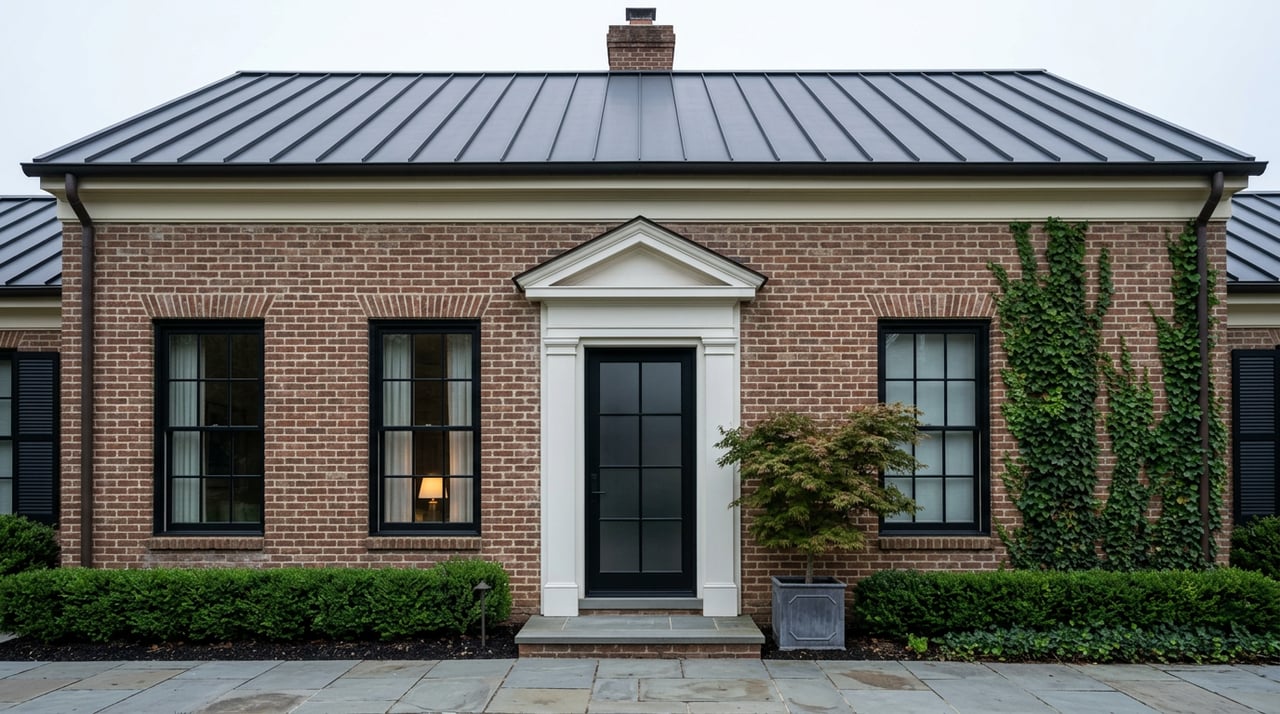
What "Carefree" Actually Costs at Traditions at Washington Crossing
September 10, 2026
September 10, 2026
How much of the price on a Traditions at Washington Crossing listing is the house, and how much is the fee schedule that comes bundled with it?
That question matters more here than in most Bucks County neighborhoods, because Traditions is the only age-restricted community inside the village of Washington Crossing, and it sells the same promise every 55+ community sells: carefree living. Gated entry. A 10,000-square-foot clubhouse with indoor and outdoor pools, tennis, and bocce. A walking trail through preserved open space. Homes built by Pulte's Del Webb brand off Wrightstown Road, split between 152 carriage homes and 147 single-family models, within walking distance of Washington Crossing Historic Park and a short drive from Crossing Vineyards and Winery. Heritage Hills sits directly across the road.
None of that changes month to month. What changes month to month is the association fee, and that number has not stayed still since the community was built in the early 2000s.
Pull the fee history and the pattern tells you something the marketing copy never will: the number has been climbing for over a decade, and it doesn't track price the way you'd expect.
| Year Referenced | Monthly HOA Fee |
|---|---|
| 2014 resales, homes from $375,000 to $680,000 | $201 to $229 |
| Community fee schedule reference, 2017 | approximately $267 |
| Current active listing, tax year 2025 | $334 |
Inside that 2014 batch, the most expensive home, a $680,000 sale, carried the lowest fee of the group at $201. A smaller, cheaper unit down the street carried $225. The fee is set by which phase and product line you're in, not by resale value, which is exactly the kind of detail a buyer comparing two Traditions listings on price alone will miss.
Then look at the trend across years. From roughly $201 to $229 in 2014, to about $267 by 2017, to $334 on a home currently listed with a 2025 tax record, the fee has climbed somewhere between 45 and 65 percent depending on which era you're measuring from. If you're pricing out a Traditions purchase using a comp from a few years back, or a fee number a friend quoted you from their own closing, you're very likely working with an outdated figure. Ask for the current fee schedule directly from the seller's disclosure, not from memory or an old listing.
There's also a separate line item that doesn't show up in the monthly number at all. Buyers moving into Traditions have historically owed a one-time capital contribution due at settlement, quoted around $1,000, on top of the monthly dues. That contribution funds the association's reserve account rather than its day-to-day operating budget, which is why it's billed once at closing instead of folded into the monthly fee. It's easy to overlook when you're focused on the sale price and the recurring HOA number, but it belongs in your closing cost math.
Traditions can legally restrict who lives there because it qualifies under the federal Housing for Older Persons Act, the exemption that lets 55-and-older communities operate outside the Fair Housing Act's usual protections for families with children. The mechanics of that exemption are worth understanding before you write an offer, because they affect real people in ways that rarely come up until they already have.
The rule requires that at least 80 percent of occupied units have at least one resident age 55 or older. That threshold applies to occupants, not owners, and only one person per household needs to clear the age bar. The Pennsylvania Association of Realtors explains it plainly: the 80 percent figure is a floor, not a ceiling, so a community isn't required to fill the remaining 20 percent with anyone in particular. HUD's own regulation, laid out in 24 CFR Part 100 Subpart E, spells out how occupied units are counted, including temporarily vacant ones where the resident intends to return.
Here's where it actually shows up at a kitchen table. A widowed spouse under 55 can typically keep living in a unit after their qualifying partner passes away, because the community's 20 percent cushion is built partly for situations like that. An adult child who inherits a parent's home in Traditions and is 48 years old can usually move in too, for the same reason. A live-in caregiver under 55 is generally accommodated as well. None of that requires a lawsuit or a variance. But if a community is already sitting close to its 80 percent line, an association's board may look more carefully at a resale to a buyer who doesn't clear the age threshold, since falling below 80 percent risks the community's legal standing entirely. This is general information about how the exemption works, not legal advice, and anyone with a specific occupancy question should raise it with the association and their own attorney before closing.
Traditions sits inside the same zip code, 18977, as land listings for 14 to 20-acre Upper Makefield parcels priced well into seven figures, some carrying 1800s stone farmhouses as guest cottages for a future main house. New construction across Upper Makefield Township, which contains the village of Washington Crossing, has recently ranged from roughly $338,000 to $25,000,000 depending on lot size and builder. One automated valuation model put the median home value across Washington Crossing at $866,153 as of August 14, 2026, up 7.21 percent year over year, a figure that only makes sense once you realize it's averaging modest attached homes against multi-acre estates in the same data set.
That spread is exactly why a buyer comparing Traditions to "the Washington Crossing median" is comparing apples to a vineyard. Traditions homes are attached and detached models on modest footprints with an HOA doing the exterior maintenance. The estate listings a few miles away are raw acreage or custom-built homes with none of that infrastructure and none of that fee. Both show up under the same search filter. Only one of them comes with a monthly bill and a capital contribution attached.
There's a third number worth flagging while you're doing this math, and it has nothing to do with the HOA. Bucks County still assesses property for tax purposes using a 1972 base year, which means the assessed value on a tax bill can look nothing like what a home actually sold for. The county applies a state-set ratio to translate between the two. It's a detail that surprises buyers moving in from counties that reassess more often, and it's worth asking your agent or the township to walk through before you budget a tax number based on the sale price alone.
If Traditions at Washington Crossing is on your list, the sale price is the smallest part of the decision. Before you write an offer, ask the seller or listing agent three things directly: when the HOA fee was last increased and by how much, whether any capital improvement assessment is pending beyond the standard settlement contribution, and how the association currently stands relative to its 80 percent occupancy threshold if that matters to your household. None of that shows up on a standard listing sheet, and all of it changes what you're actually signing up to pay and who's actually eligible to live there.
Is the monthly HOA fee the same for every home in Traditions at Washington Crossing? No. Fees vary by section and model, and the historical data shows fee amounts don't track resale price in a straightforward way. Always request the current fee for the specific unit you're considering rather than relying on a fee quoted for a different home in the community.
Can someone under 55 buy a home in Traditions at Washington Crossing? It depends on the household. HOPA's 80/20 rule allows a portion of occupied units to include residents under 55, commonly spouses, caregivers, or family members in inherited-property situations. Whether a specific purchase is permitted depends on the community's current occupancy standing and its governing documents, which is a question for the association and an attorney rather than a general rule.
Does the capital contribution apply every time a home resells? Capital contributions at settlement have historically applied to buyers entering the community, separate from the monthly dues. Confirm the current amount and whether it applies to your specific transaction directly with the seller's disclosure packet, since community fee structures can be updated over time.
If you're weighing a purchase in Traditions at Washington Crossing against a larger property elsewhere in Upper Makefield, or you're not sure which product actually fits how you want to live, that's exactly the kind of comparison worth working through with someone who tracks this market closely. Steven Dome can walk you through the current fee schedule, the occupancy math, and what the rest of Washington Crossing actually offers at every price point. Let's Connect.
September 17, 2026
September 17, 2026
September 10, 2026
September 3, 2026
September 2, 2026
September 2, 2026
August 27, 2026
August 20, 2026
August 13, 2026
Get assistance in determining current property value, crafting a competitive offer, writing and negotiating a contract, and much more. Contact me today.
Contact me to learn more.

550 Union Square Drive New Hope, PA 18938