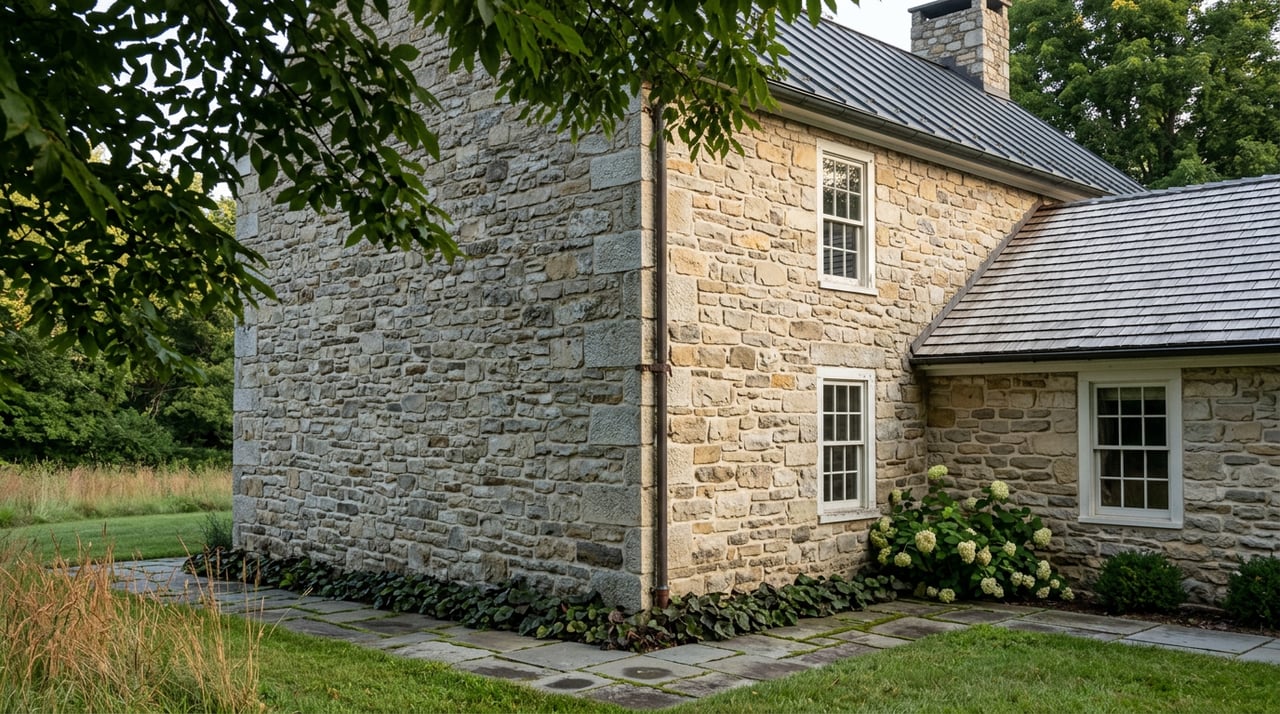
Three Things That Surface After You Go Under Contract on a Solebury Property
Steven Dome June 18, 2026
Steven Dome June 18, 2026
A Solebury listing reads simply enough on the portals. Stone farmhouse, acreage, a creek somewhere on the parcel, a price that tracks with what northern Bucks County properties have done for the last two years. The portal does not show the septic permit file at the Bucks County Department of Health, the water chemistry from the well two hundred feet behind the barn, or the conservation easement recorded against the deed in 1998. Those three documents decide whether your transaction closes on schedule, closes with renegotiation, or quietly falls apart.
If you are buying in Solebury Township for the first time and your reference point is a Philadelphia rowhome or a Lower Bucks subdivision on public water and sewer, the contract date is not the finish line of the search. It is the start of a thirty-day window in which three property systems you cannot see from the road have to be checked, interpreted, and priced into the deal. None of them are exotic. All of them are routine in Solebury and easy to miss anywhere else.
Pennsylvania does not require a statewide point-of-sale septic inspection, which is the first thing buyers from out of state get wrong. Pennsylvania doesn't mandate septic inspections statewide for home sales, but many municipalities do, and most buyers' agents recommend one regardless. Skipping it to save a few hundred dollars can mean inheriting a failing drain field that costs $10,000 or more to replace.
Solebury sits one layer deeper than that. The Township operates its own Sewage Management Program that requires all property owners with a septic system to have it pumped and visually inspected every three years. The receipt has to be submitted to the Township with the parcel number on it, and it can be scanned and emailed to [email protected], faxed to 215-297-8402, or mailed in. The relevant question during due diligence is not only whether the tank works. It is whether the seller has been in compliance with the three-year cycle, because a file with gaps in it transfers to you on closing day.
New systems, repairs, and replacements are permitted through the Bucks County Department of Health at 215-345-3318 under Act 537 and 25 Pa. Code Chapter 73, and a certified Sewage Enforcement Officer is the one who evaluates the soil and signs off on the design. Pending weather, this permitting process can generally take three to eight weeks. That window matters if an inspection turns up a failing absorption field, because the seller cannot simply hire a contractor and resolve it the way a roof repair gets resolved. The fix runs through the county on the county's calendar.
Two practical numbers to hold in mind. A PA septic inspection is one of the smartest investments you can make before buying a home with an on-lot sewage system. For $300 to $600, you get a clear picture of whether the system works, how long it might last, and whether expensive repairs are on the horizon. And many older homes in Bucks County and Montgomery County sit on original septic systems from the 1950s and 1960s that are reaching end of life. A 1960s tank that has been faithfully pumped every three years is a different asset than the same tank with no paper trail.
Before you write the contract, ask the listing side for three things:
If the seller cannot produce them, that is not a deal killer. It is a pricing input.
The instinct from a public-water background is to ask a neighbor how the water tastes. In Solebury that instinct is misleading. The U.S. Geological Survey conducted a detailed study of northern Bucks County groundwater in cooperation with New Hope Borough and surrounding townships including Solebury, Buckingham, Plumstead, Tinicum, and Wrightstown. That study documented water quality across more than 1,300 wells and found wide variation in pH, metals, radon, volatile organic compounds, and other parameters depending on which rock formation a well taps into. The Triassic-age sedimentary rocks underlying much of this area, along with pockets of carbonate rock and diabase intrusions, create different water chemistry in wells that may be just a few hundred yards apart. A neighbor with great water does not tell you much about your own.
That single fact reorders the inspection contingency. You are not testing a representative water sample for the area. You are testing this well, on this parcel, this month.
There are two separate items most Solebury buyers conflate. A water quality test tells you what's in the water. A well inspection tells you whether the system delivering that water is in good shape. These are two different things, and you need both. The water test covers bacteria, nitrates, metals, and the contaminants specific to the property's surroundings. The mechanical inspection covers the casing, the cap, the pump, and the pressure tank.
Two location-specific contaminants belong on the test list in Solebury more than they belong on a generic checklist. Properties in Buckingham, Plumstead, or rural Solebury should test for nitrates, pesticides, and herbicides if any active farmland sits upgradient. And PFAS deserves a hard look. The Bucks County Water and Sewer Authority serves some properties in the New Hope and Solebury area through its own groundwater wells, but BCWSA has been publicly identified as out of compliance with Pennsylvania's PFAS regulations at its Solebury-area wells, with detected levels as high as 47 parts per trillion in September readings. The EPA finalized maximum contaminant levels for six PFAS compounds in 2024. If the public supplier in your part of the township is testing above the federal limit, a private well in the same recharge area is worth a test of its own.
The Pennsylvania Department of Environmental Protection does not test private wells for you. That responsibility falls to you as the homeowner.
That DEP framework is the regulatory baseline, and it is why the contract contingency, not the closing, is the moment to spend money on testing. If you are buying or selling a home with well water in Solebury, Buckingham, Upper Makefield, or any of the surrounding townships, schedule testing early in the process. DEP-compliant testing takes several days to complete, and a slow lab can eat half of an inspection window.
The third item is the one buyers rarely think to look for because it is filed in the chain of title rather than attached to the physical property. Solebury is unusual in the scale and seriousness of its land preservation program, and the easements that program produced are now embedded in hundreds of deeds.
The numbers are worth seeing in one place. 3,868 acres have been protected by the Township Land Preservation Program. Additionally, the Heritage Conservancy has protected 984 acres, Natural Lands Trust 990 acres, and the Township, State, and County have 849 acres in protected parks and open space. Of the 17,376 acres in Solebury, 6,691 acres, 38.5 percent of Township land, enjoy some protection from further development. That preservation was paid for by the residents themselves. In 1996, 1999, 2002, 2005, and 2019, residents overwhelmingly agreed to fund preservation by $56 million, approving referendums by an average of 90%.
| Easement holder type | Acres preserved in Solebury |
|---|---|
| Solebury Township program | 3,868 |
| Heritage Conservancy | 984 |
| Natural Lands Trust | 990 |
| Township, State, County parks and open space | 849 |
| Total protected | 6,691 |
What this means for a buyer under contract: if the property you are buying is one of those preserved parcels, the easement does not expire when the seller signs the deed. The grant of a conservation easement, as with any real property interest, is part of the chain of title for the property and is recorded in local land records. The conservation easement runs with the land, meaning it is applicable to both present and future owners of the land. The restrictions are perpetual.
The structure of the agreement is also specific to Solebury. Solebury co-holds conservation easements with Heritage Conservancy and Land Trust of Bucks County. The property may be sold or willed to someone else, but all future owners are bound by the terms of the easement and are subject to yearly compliance reviews. You inherit not only the restriction but the annual relationship with the co-holder who monitors the land.
A title commitment on a preserved Solebury parcel will list the easement as an exception. Read it. The document itself will spell out where you can build, where you cannot, what counts as agricultural use, what counts as landscape disturbance, and what triggers a compliance review. There is a third type of easement, a facade easement, which protects the exterior of historic buildings. Facade easements are expected to become a larger part of Solebury's preservation program. If you are buying a stone house in a village like Carversville or Lumberville with restoration plans, that detail is the difference between a free hand and a permitting conversation.
The three items are not equally urgent, and the order matters when the inspection window is short.
Week one belongs to the well water test, because the lab turnaround is the slowest variable in the chain and a positive result for bacteria, nitrates, or PFAS reshapes everything downstream. Week one also belongs to the title search, which is when any recorded easement will surface and the actual restriction document can be ordered from the county. Week two is the septic inspection and the Solebury Township compliance file review, which a buyer's agent can request directly from the Township. Week three is for the mechanical well inspection on pump, pressure tank, and casing, and for any follow-up testing if the first round flagged something. Week four is for renegotiation, repair credits, or extension requests, which is what the contingency period is actually for.
A Solebury closing rarely fails because of any one of these. It fails when a buyer treats the contract date as the end of due diligence rather than the beginning, and runs out of calendar to act on what the documents say.
Does Solebury require a septic inspection at the point of sale? The Township does not impose a separate point-of-sale septic inspection ordinance the way some Pennsylvania municipalities do. It requires three-year pump-and-inspect compliance on every on-lot system, and that file transfers with the property. Most buyers' agents in northern Bucks County still recommend a private inspection during the contingency window.
Who pays for the septic inspection in a Solebury transaction? In most Pennsylvania real estate transactions the buyer pays for the septic inspection as part of due diligence. However, if the municipality requires a point of sale inspection, the seller typically handles it. Solebury does not, so the cost normally sits with the buyer.
How do I know if a Solebury property is under a conservation easement before I write an offer? The fastest signal is acreage and price relative to comparable unrestricted parcels. The definitive answer comes from the title search and from the Solebury Township Land Preservation page, which lists the program and its co-holding partners. If the seller's disclosure references an easement, request the recorded document before the inspection deadline rather than after.
Is BCWSA the only water utility in Solebury? No. Two water authorities and one private company deliver water to their specific communities. The Bucks County Water and Sewer Authority oversees wastewater removal in its jurisdiction. The Bucks County Board of Health oversees water activities, and the Pennsylvania DEP has a say in major water issues. North Wales Water Authority and Aqua PA also serve portions of the area. Most Solebury properties, however, remain on private wells.
If you are evaluating a Solebury property and want a second read on the septic file, the well chemistry, or what an easement actually allows you to build, that is the kind of work Steven Dome does before the contract is signed. Let's Connect.
August 20, 2026
August 13, 2026

August 12, 2026

August 12, 2026
August 12, 2026

August 9, 2026

August 8, 2026

August 6, 2026
August 3, 2026
Get assistance in determining current property value, crafting a competitive offer, writing and negotiating a contract, and much more. Contact me today.
Contact me to learn more.

550 Union Square Drive New Hope, PA 18938