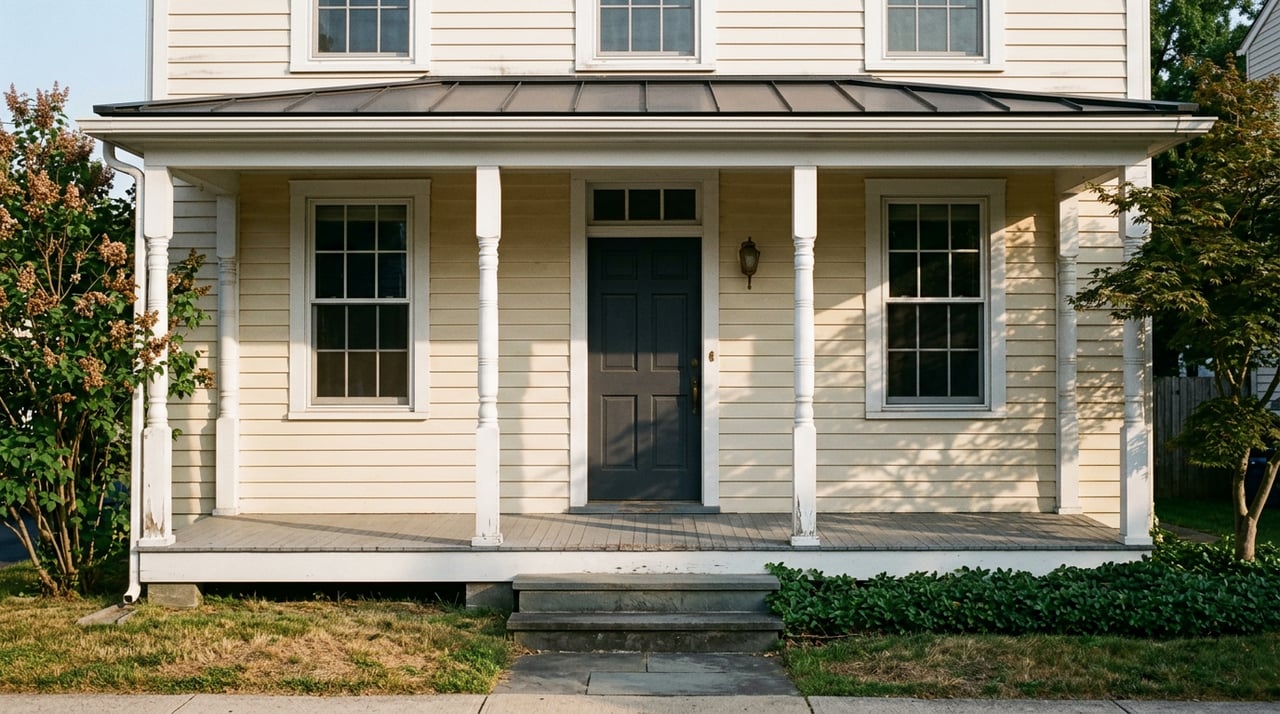
What Doylestown PA Housing Market 2026 Means for Buyers
Steven Dome May 28, 2026
Steven Dome May 28, 2026
If you've been tracking Doylestown on the portals, you've probably noticed something that doesn't quite fit. Prices are climbing — sharply. The median sold price in the 18901 zip code reached $695,000 in March 2026, up 26.1% from the same month a year earlier, with 70 closed sales in that single month compared to 62 the year before. Transaction volume is rising. Price growth is real.
And yet homes are sitting longer. The average days on market in 18901 climbed to 48 days in March 2026, compared to 34 days the year prior. That's a 41% increase in time-to-close, running alongside a 26% increase in price. Both trends are happening simultaneously, in the same zip code, in the same season.
Most buyers see those two numbers and assume a softening market. That reading is wrong, and acting on it will cost you.
In May 2026, the median list price in Doylestown was approximately $899,000. The median sold price in March 2026 was $695,000. That's a headline gap of roughly $200,000, and it looks like a buyer's dream — until you check what it actually represents.
The gap isn't evidence that sellers are capitulating. It's evidence that the market has split into two pools that behave nothing alike.
| Sub-Market | Median Sold Price | Avg. Days on Market | Notes |
|---|---|---|---|
| 18901 zip (broad) | $695K (March 2026) | 48 days | Volume up YoY; 70 sales |
| Doylestown Historic District | $1.1M (February 2026) | 80 days | Small sample; price/sqft up 76% YoY |
| 18901 active listings | $899K median list (May 2026) | 17 days median active | Faster churn on new inventory |
The Historic District's $1.1M median sounds like it's falling — it's down 35.6% year-over-year. But that figure covers six sales in February. One outlier in either direction moves it by hundreds of thousands. The price-per-square-foot in the Historic District, which is less sensitive to sample size, is up 76.2% year-over-year. The direction of travel in the borough's most walkable, most sought-after block is unambiguously upward.
The broad zip code tells the same story at a less dramatic scale. At $308 per square foot sold, Doylestown is trading at a 1.3% discount to median list price per square foot. The headline price gap is enormous; the per-square-foot execution gap is almost nothing. Sellers who price by comparable square footage aren't giving much away.
Spring 2026 closed transactions in the 18901 zip show a spread that should change how you read any aggregate number here.
One property sold in April 2026 for $1,035,000 — 6% over its $975,000 list price — after 83 days on market. Another sold that same month for $600,000 — 8% below its $649,900 ask — after 332 days. Both are in the same zip code. Both closed in the same season.
That spread isn't noise. It's the market's signal. The 83-day property didn't sit because demand was weak. It sat because it was priced at the upper end of its segment, took time to find the right buyer, and then closed above list. The 332-day property wasn't ignored because the market was slow. It was ignored — and then discounted — because something about the pricing, the condition, or the presentation didn't clear the bar buyers have set in this market.
When a home in Doylestown sits past 30 days without a price adjustment, that's not a negotiating opportunity. It's diagnostic data. Something is off, and buyers here have shown they'd rather wait than overpay to inherit a problem.
Longer days on market usually accompany price softening. In Doylestown right now, they don't. The reason has to do with who's shopping.
Between October and December 2025, New York metro buyers were searching into Doylestown more than buyers from any other metropolitan area outside the region. Los Angeles and Hartford followed. These are buyers coming from markets where $695,000 buys considerably less than a historic-district colonial with walkable access to State Street. Their reference price is not the Bucks County median. Their anchor is the last comparable property they considered in their origin market.
That external pressure sustains the floor. A Bucks County move-up buyer who's watched the market for two years will balk at a 26% increase. A buyer relocating from Brooklyn is doing different math entirely.
At the same time, the 18901 active listing median of $899K and a 17-day median time active for current inventory — compared to the 48-day average for closed sales — suggests new inventory is moving faster than the backlog. The homes sitting 80, 100, 200 days are pulling the average up. Fresh, well-priced listings are not the story those averages are telling.
The practical read is this: Doylestown is not a market where patience uniformly rewards buyers. It's a market where patience rewards buyers who are waiting for the right home, and punishes buyers who are waiting for the market to soften broadly.
The homes that move in under 20 days — and some do, even now — are typically priced at or slightly below the recent comparable cluster, in move-in condition, and in the borough or in close-in township locations with walkable access. They still receive multiple offers. In February 2026, the average closed transaction in the city of Doylestown received five offers.
The homes sitting past 60 days are in the township, on more land, asking prices that reflect the seller's renovation investment rather than the buyer's appetite for it, or both. Those homes will eventually sell — often for meaningful discounts — but they are not representative of what you'll face when you make an offer on the property you actually want.
Knowing which pool a listing belongs to is the work. A home that's been active for 45 days in the 18901 zip isn't necessarily a soft target. If it's been sitting because of condition issues and you're not prepared to take on those issues, the discount isn't a deal. If it's been sitting because the seller priced above the comparable cluster and has since done nothing, that's a different conversation.
Is Doylestown a buyer's or seller's market right now?
It depends on which Doylestown you mean. For well-priced, move-in-ready homes in the borough and close-in locations, sellers still hold leverage — five offers on average in recent months, and prices up year-over-year. For township homes with extended days on market and multiple price reductions, buyers have more room. The aggregate numbers average those two experiences into something that describes neither accurately.
Why is the median list price so much higher than the median sold price?
The $899K list median (May 2026) and $695K sold median (March 2026) come from different data sets at different points in time, and the listing pool includes homes at every stage of their market cycle — including properties that have been sitting for months at aspirational prices. The sold median reflects what buyers actually agreed to pay. At the per-square-foot level, the gap between list and sold narrows to about 1.3%, which is a more honest picture of execution.
Should I wait for prices to drop?
That's a question about your timeline, not market prediction. Transaction volume in 18901 rose year-over-year in March 2026. External buyer demand from high-cost metros is sustaining the price floor. The homes that have dropped in price are dropping for property-specific reasons, not because the market is softening overall. Waiting for a broad correction while a narrow set of compelling homes continues to move quickly is a real risk.
If you're working through what Doylestown's market means for your specific search, Steven Dome can help you read the signals that matter for the price range and property type you're actually targeting. Reach out whenever you're ready.
August 20, 2026
August 13, 2026

August 12, 2026
August 12, 2026
August 12, 2026
August 9, 2026
August 8, 2026
August 6, 2026
August 3, 2026
Get assistance in determining current property value, crafting a competitive offer, writing and negotiating a contract, and much more. Contact me today.
Contact me to learn more.

550 Union Square Drive New Hope, PA 18938