The Buckingham Township Median Is a Policy Artifact. Here's What That Means for a Buyer.
Steven Dome July 27, 2026
Steven Dome July 27, 2026
If you have already looked at Buckingham Township on a portal, you have seen a median hovering somewhere around $708,000 to $760,000 as of the first half of 2026, and you have probably assumed the number describes what a house here costs. It doesn't. It describes an average of two sub-markets that share a mailing convention and almost nothing else, and the gap between them is held open by zoning decisions made three decades ago.
That matters before you write an offer. It also matters at settlement, where a Buckingham purchase behaves differently than a resale in most surrounding townships in two specific ways worth knowing up front.
The price you pay in Buckingham is less a function of the house than of which zoning district the house sits in and what is preserved next door. The market cannot arbitrage that gap away because the policy makes the gap permanent.
Buckingham is 33 square miles, and more than half of it sits inside two agricultural zoning districts, AG-1 and AG-2, where by-right density in these zones is one unit per 1.8 acres. Density can rise inside those districts only when a landowner clusters development on part of the parcel or brings in transferable development rights from another qualifying farm, and to qualify for clustering options, land zoned AG-1 and AG-2 must be at least 25 acres in size.
Everywhere else, the ordinance concentrates growth. In the Planned Business & Residential District and the Village Residential-3 District, the base density of five units per acre can be increased to 15 units per acre by transferring one development right for each additional unit, and in the R-1 residential district, base density can be increased by 40 percent for cluster subdivisions using TDR. In the Village Residential-1 District, the maximum density can be doubled for cluster subdivisions using TDR.
Layered on top of that zoning framework is a preservation program voters have funded three separate times. Buckingham residents approved bonds in 1995, 1999, and again in 2008, when with a vote of 82 percent in favor, voters overwhelmingly approved a third referendum which allows the township to borrow up to 20 million additional dollars to fund the next great push to preserve Buckingham's historic heritage of farmland and open spaces. The cumulative result is that as of 2025, 6475 acres of land have been permanently protected from development in Buckingham.
The takeaway for a buyer: on any given Buckingham parcel, the ordinance and the acres around it have already decided whether the lot next door can ever be subdivided. That answer is priced in.
Because of that framework, Buckingham does not have a single housing market. It has three, and comparable sales from one tier tell you almost nothing about pricing in another.
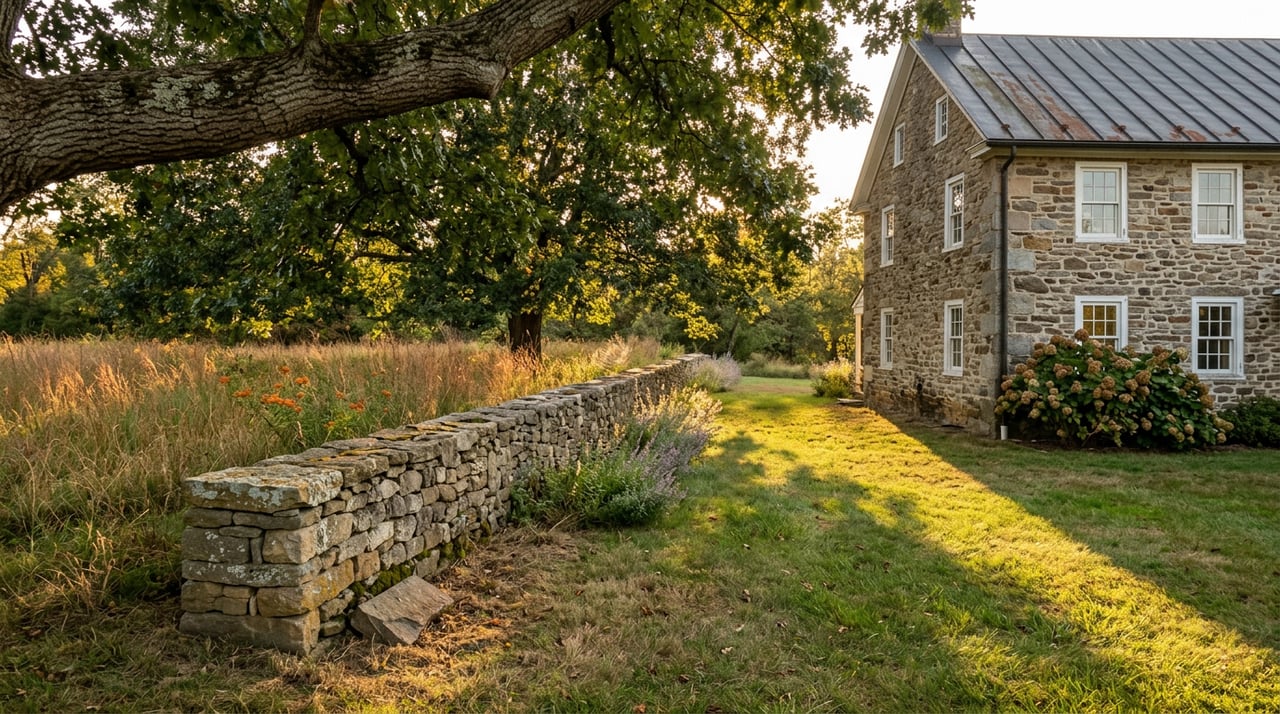
A $650,000 colonial in a planned community and a $1.6 million stone farmhouse restoration on Smoke Road both carry Buckingham Township addresses. Reading one as a comp for the other is the most common mistake buyers make here.
The reason the top tier trades where it trades is that the neighbor next door is a document filed with the county. The easement is filed with the Bucks County Recorder of Deeds and "runs with the land." That means that the owners can continue to farm the land, pass it on to their children or sell it, but no owner, now or in the future, can develop it.
The pipeline of new easements is still active. In early 2026, Heritage Conservancy closed on the 102-acre Maximuck farm at Long Lane and Street Road, which completes 257 acres of contiguous farmland preservation that spans Buckingham and Solebury Townships. A few months later, the state announced additional Bucks County preservation funding, and a 32-acre crop farm owned by Debra A. and Frank Ripp Jr. in Buckingham Township was preserved alongside a 17-acre farm owned by Gary G. and Linda K. Bender in Milford Township.
Each new easement removes a specific quantity of developable acreage from the future supply. That is why Buckingham inventory stays thin, and it is why homes that already border preserved land trade at a premium that widens rather than compresses over time. There is no version of the ordinance that produces more of these lots.
Buckingham handles resales differently from most surrounding municipalities in two ways, and both are worth flagging before the inspection period.
The first is what the township does not require. Per Code Enforcement, Buckingham Township does not currently require inspections or new Use & Occupancy permits for existing homes that are being resold. If you are used to the borough or township next door running a resale inspection with a list of pre-settlement corrections, that check does not happen here. That is not a permission slip. It means the private home inspection is doing all of the work, and on older stone farmhouses the private inspection needs to be scoped accordingly, particularly for well, septic, chimney, and non-conforming additions.
The second is what the township does require after closing. Buckingham Township requires all new property owners to register their deed with the township. We will be unable to issue any permits for a property until the current property owner's deed is on file. Title companies typically handle this, but not always. If a buyer plans to pull a permit for a renovation, a pool, or even a shed in the first year, an unregistered deed will stop the permit at the counter.
Neither item shows up on the listing. Both are routine to handle when you know they exist.
A few checks that translate the ordinance into a shopping process:
No. The easement affects the neighbor's assessed value, not yours. What it does affect is the durability of your view and your privacy, which is priced into your acquisition cost and, over time, into your resale.
Yes, within the ordinance's density and dimensional requirements. The AG-1 and AG-2 districts allow residential use at a base of one unit per 1.8 acres and permit clustered subdivisions on parcels of at least 25 acres. What you cannot do is subdivide a small parcel further or exceed the base density without acquiring transferable development rights, which the township administers under Article 34 of the zoning ordinance.
The single most useful thing to internalize before shopping in Buckingham is that the median is not describing your house. It is describing three markets averaged together, and the one you are actually shopping in has its own comps, its own supply mechanics, and its own transaction habits. Pricing a specific parcel correctly is a matter of matching it to the right tier and reading the ordinance and the easements that surround it.
If you are weighing Buckingham against Doylestown, Solebury, or Newtown and want a read on which tier your search actually belongs in, Steven Dome is happy to walk the parcel, pull the file, and price it against the right comparables. Let's Connect.
August 20, 2026
August 13, 2026
August 12, 2026
August 12, 2026
August 12, 2026
August 9, 2026
August 8, 2026
August 6, 2026
August 3, 2026
Get assistance in determining current property value, crafting a competitive offer, writing and negotiating a contract, and much more. Contact me today.
Contact me to learn more.

550 Union Square Drive New Hope, PA 18938