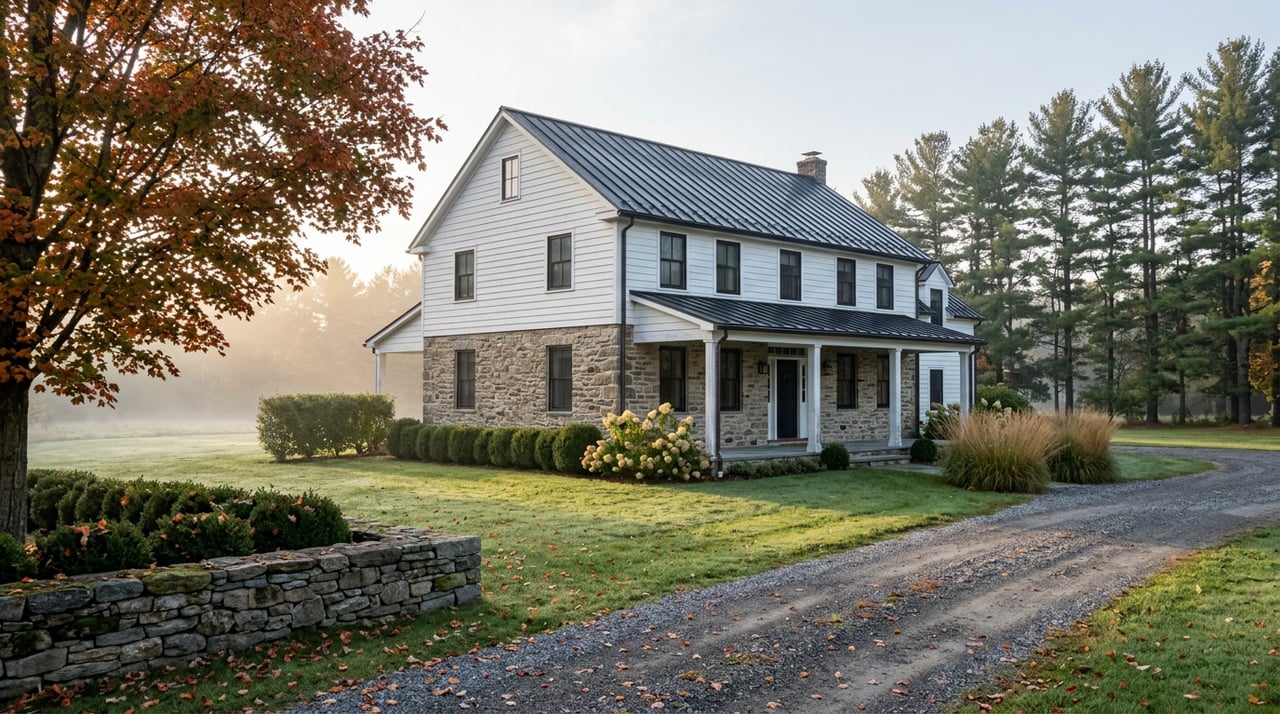
The Water Question Every Solebury Buyer Should Ask Before the Home Inspection
Steven Dome September 24, 2026
Steven Dome September 24, 2026
Before you sign an agreement of sale on a house in Solebury Township, there's a question worth asking that has nothing to do with price per square foot or the age of the roof: who has actually tested this water, and when?
It sounds like a minor detail next to a $700,000 stone farmhouse or a renovated cottage in Carversville. It isn't. In most of Bucks County's river towns, the answer to that question depends entirely on which side of an invisible line the property sits on, and the line runs through the middle of Solebury itself. Get the answer wrong, or skip the question entirely, and you inherit a problem that a standard home inspection was never built to catch.
If you're moving from a Philadelphia rowhouse or a New Jersey townhouse, you probably carry an unspoken assumption: municipal water is tested and regulated, so it's the safer bet, and a private well is the thing you have to worry about. In Solebury Township, that assumption gets tested almost immediately, because the one slice of the township that runs on public water has a documented contamination problem, and it's the kind most buyers never think to ask about.
A narrow corridor along Route 202, north of Aquetong Road, is served by the Bucks County Water and Sewer Authority. Everywhere else in Solebury, homes draw from private wells and dispose of wastewater through on-lot septic systems. That split matters more than it looks, because the two sides of that line carry different risks, different paperwork, and different responsibilities for a buyer to sort out before closing.
BCWSA first detected PFAS, the so-called forever chemicals, in its New Hope water supply back in 2016, years before either the federal or state government had set an enforceable limit. Pennsylvania's Department of Environmental Protection has since set its own limits of 18 parts per trillion for PFOS and 14 parts per trillion for PFOA, and the federal government finalized its first national PFAS drinking water standard in 2024. As of the most recent public reporting, BCWSA's New Hope and Solebury systems have continued to test above those limits, with levels reported as high as 47 parts per trillion for PFOS in one sampling round, more than double the state threshold. WHYY reported that the New Hope and Solebury systems were among six Philadelphia-region providers still out of compliance as of last year, and among 22 statewide.
BCWSA hasn't sat still on this. The authority piloted a treatment technology called Advanced Molecular Oxidation, developed with a company called TruClear Water Solutions, and independent lab results showed the system removing 90 to 100 percent of PFAS during testing. The authority is waiting on DEP approval to make that treatment permanent. In the meantime, if you're buying a home on the BCWSA side of that Route 202 line, ask for the system's current Consumer Confidence Report before you get too far into a transaction. It's a five-minute request that tells you exactly where things stand.
Worth knowing too: Solebury's BCWSA system had a boil water advisory this past summer, issued July 11, 2026 and lifted four days later. Nothing about that timeline suggests an ongoing crisis. It does mean this is an actively monitored system with real events on the record, not a quiet utility bill you never think about.
Step off that Route 202 corridor and the picture flips completely. The majority of homes in Solebury sit on private wells, and Pennsylvania's DEP does not monitor private wells at all. There is no Consumer Confidence Report, no utility inspector, no regulatory floor. A well can sit untested for a decade and nothing will flag it, because nothing is watching.
That doesn't mean private well water in Solebury is uniquely risky. It means the responsibility for knowing what's coming out of the tap sits entirely with the property owner, and by extension, with the buyer at closing. Two houses on the same road can pull from different depths of the same bedrock and come back with completely different results.
The geology here shapes what shows up. Limestone and shale formations across northern Bucks County produce naturally hard water, so calcium and magnesium buildup on fixtures and inside water heaters is common and mostly a cosmetic and maintenance issue rather than a health one. Iron and manganese from the local bedrock cause the orange-brown staining many longtime well owners in the area have simply learned to live with. If you're touring a historic stone house with original plumbing, low pH groundwater is also worth a thought, since acidic water corrodes older copper and brass fittings over time, something that matters more in a 200-year-old farmhouse than it does in new construction.
Then there's the seasonal risk tied directly to the land itself. Solebury's active farmland drains into Pidcock Creek, Cuttalossa Creek, Paunnacussing Creek, and Aquetong Creek, and after a heavy rain, agricultural runoff can push nitrates and bacteria into shallow wells nearby. The DEP recommends annual testing for coliform bacteria and nitrates for every private well owner in the state. It's a recommendation, not a requirement, which is exactly why it gets skipped.
Here's the part that surprises a lot of buyers coming from other states: Pennsylvania has no statewide law requiring a well or septic inspection at the time of sale. There's no automatic trigger, no state form that forces the issue. What actually happens at closing is shaped by two things instead: your lender's underwriting rules, and Solebury Township's own local ordinance.
Most mortgage lenders will require at least a basic water test before approving a loan on a well-served property, but that basic test is a narrow one, typically just coliform bacteria, nitrates, and pH. It satisfies the lender's checklist. It tells you almost nothing about PFAS, heavy metals, or the volatile organic compounds that a more thorough panel would catch.
Basic real estate test | Comprehensive panel | |
|---|---|---|
What it covers | Coliform bacteria, nitrates, pH | Adds hardness, iron, manganese, lead, PFAS, VOCs |
Who requires it | Most mortgage lenders as a closing condition | Nobody, it's the buyer's choice |
What it tells you | Whether the loan can close | What you're actually inheriting |
Typical cost as of 2026 | Roughly $200 to $400 | Roughly $300 to $600 |
The gap between those two columns is where problems hide. A well can pass the lender's checkbox test and still carry issues the basic panel was never designed to find.
Solebury Township took a more active stance on wastewater than the state requires. Since 2014, the township's own Sewage Management Program has mandated that every septic system be pumped and visually inspected once every three years, with the hauler's report filed back to the township along with the property's tax parcel number. It's a genuinely useful record for a buyer to request, because it tells you whether the current owner has kept up with basic maintenance.
It is not, however, the same thing as a real assessment of whether the system will hold up. A pump-out and visual check confirms the tank isn't overdue for service. It doesn't load-test the drain field or rule out a system nearing the end of its functional life. For that, Penn State Extension recommends a full septic evaluation performed by a certified inspector using established protocols, distinct from a general home inspection, and as of 2026 that kind of evaluation typically runs $350 to $700 in this part of Pennsylvania. Skipping it and relying only on the township's pump-out record is a bit like checking that a car's oil has been changed without ever asking whether the engine runs.
If you're under agreement on a Solebury property, or getting close to it, this is the short version of what to ask for:
None of this should scare you off a Solebury address. It should just replace price-per-square-foot as the first number you ask about.
If a home is on BCWSA public water in Solebury, do I still need to worry about water quality? It's worth a look either way. Ask for the current Consumer Confidence Report and check the system's PFAS treatment status before assuming public water means nothing left to check.
Does an overdue septic pump-out kill a deal? Not usually. It's a maintenance item that can typically be scheduled and resolved before or shortly after closing, and Solebury's own township program makes the requirement and process straightforward to document.
Is PFAS contamination a reason to avoid buying in Solebury? The documented issue is specific to the small BCWSA-served corridor along Route 202, and the authority has an active treatment plan underway. For the much larger share of the township on private wells, the relevant risks are different, mostly hardness, iron, and seasonal nitrates, and a comprehensive test before closing is the way to know what you're actually getting.
Water and wastewater rarely make it into a listing photo, but they shape a Solebury transaction more than almost anything else on the checklist. If you're looking at property in Solebury, or trying to figure out which side of that Route 202 line makes sense for how you want to live, Steven Dome can walk you through what a specific address actually means for testing, timing, and what to ask for before you write an offer. Let's Connect.
October 1, 2026

September 24, 2026

September 24, 2026

September 24, 2026

September 24, 2026

September 24, 2026
September 24, 2026
September 17, 2026

September 17, 2026
Get assistance in determining current property value, crafting a competitive offer, writing and negotiating a contract, and much more. Contact me today.
Contact me to learn more.

550 Union Square Drive New Hope, PA 18938